Amsterdam-Zuidoost | Leisure
‘Zuidoost’s growth depends on strong collaboration’
Tanja Dik | Johan Cruijff ArenA
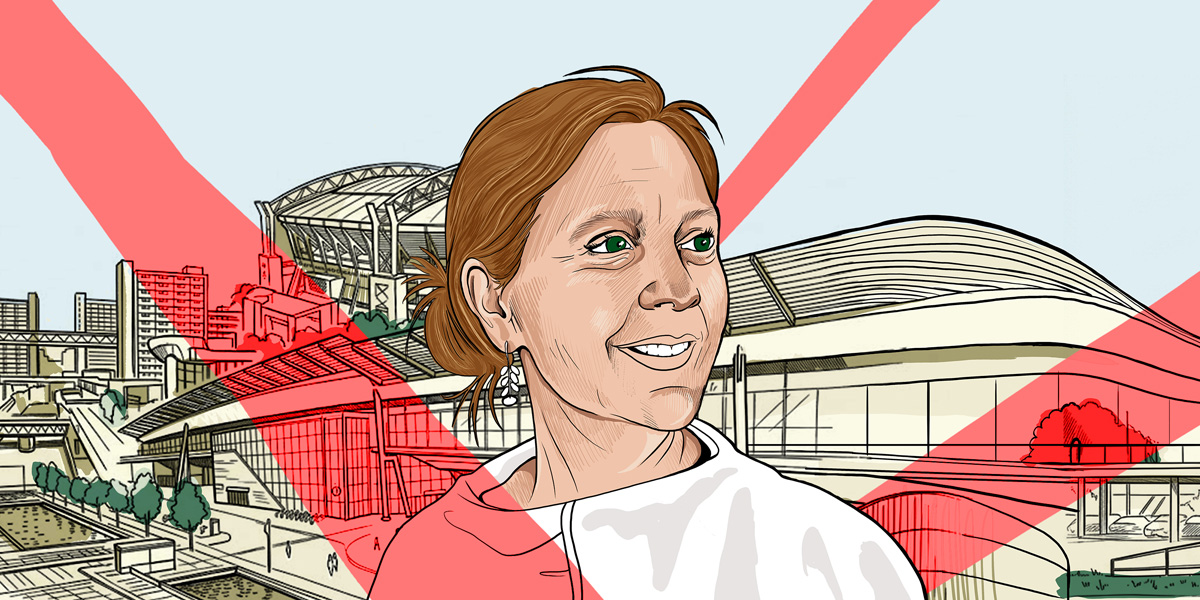
Entertainment, residential development and employment can strengthen one another in Amsterdam-Zuidoost, says Tanja Dik, CEO of the Johan Cruijff ArenA. However, as more functions and more people are added to the area, pressure on infrastructure and public space will continue to increase. ‘At times, we are already operating close to capacity,’ she says. ‘With the planned growth, that challenge will only become greater.’
According to Tanja, close coordination between all planned developments is essential. She also points to investments in public transport as a key condition for further densification. ‘Residents, businesses and public-sector organizations each have their own role to play and must work together to shape the future of Zuidoost.’
Good accessibility is equally important for real estate investors, she emphasizes. Through visits to other urban development areas, she learned that investment only truly accelerated once there was confidence that mobility and transport connections would be adequately addressed. ‘If as many as 50,000 homes and 30,000 jobs are added to Zuidoost, this will be a crucial issue.’
Wembley Park as a source of inspiration
For Tanja, Wembley Park in London is an important example. She visited the area together with the organizations collaborating in Zuidoost and saw how housing, entertainment and mobility can successfully coexist in close proximity. A strong partnership between the landowner, local authority and transport operator played a key role in that success.
Residents, businesses and public-sector organizations each have their own role to play and must work together to shape the future of Zuidoost.
The most important lesson from this regeneration project is not simply the expansion of infrastructure. According to Tanja, the real value lies in the quality of place created around the stadium district. ‘Retailers, residents and other stakeholders have worked together to create a place people visit even when no event is taking place,’ she explains. ‘That is an area where Zuidoost can still make progress.’
By this, she does not mean that visitors should stay in Zuidoost en masse after a concert or football match. Many ArenA visitors travel from well beyond Amsterdam and return home afterwards. Rather, she believes Zuidoost should continue developing the amenities and attractions needed to become a broader destination throughout the week and throughout the day.
From separate districts to one
For that vision to succeed, stronger connections within Zuidoost itself are needed. Tanja regrets that people still talk about the two sides of the railway as though they are entirely separate worlds. While she would not describe it in those terms herself, she does recognize a degree of fragmentation within the area.
She would like to overcome that fragmentation not only physically but also in how people experience the area. As an example, she points to the idea of a distinctive colored element, rooted in the area's identity, that could appear on both sides of the railway line. ‘Not as a complete solution, but as a recognizable feature that shows this all belongs to the same Zuidoost. Something that helps people on both sides of the railway feel connected to the same place.’
Connecting with the surrounding community
This transformation also brings challenges. Alongside football matches, dozens of concerts take place at the Johan Cruijff ArenA each summer. As more homes are built in the immediate vicinity, managing noise levels becomes increasingly important.
‘We want the stadium to become an even more integral part of the neighborhood.’
In recent years, the ArenA has invested approximately €3.5 million in an advanced acoustic system, partly to further reduce noise disturbance. ‘Of course, concerts generate sound. That means densification is not just about building. It is also about making clear agreements in advance on how residential communities and entertainment venues can coexist.’
This also touches on a broader lesson from the stadium's history. ‘The ArenA was originally designed almost like a fortress, with relatively little connection to its surroundings. We already do a great deal together with the local community, but we would like to lower the barriers to physical access even further, especially as the area continues to evolve.’
The ArenA as a living laboratory
The Johan Cruijff ArenA wants to play an active role in that process. In the areas of innovation and sustainability, Tanja views the stadium as a living laboratory where new solutions can be tested in practice and where other organizations can participate.
With solar panels, batteries and its own local energy system, the ArenA can experiment with generating, storing and using energy. Tanja hopes such innovations will also benefit the surrounding community. For example, she would like surplus energy to help address energy poverty in nearby neighborhoods, although current regulations do not yet allow this.
‘I genuinely believe it will happen here.’
The stadium also works to strengthen its social ties with the local community. Hospitality suites are used for after-school study programs for local children, neighborhood days include free stadium tours, residents can attend job fairs, and facilities are made available for community organizations hosting holiday dinners. When complimentary tickets are distributed, Tanja deliberately leaves the selection process to local community coordinators. ‘I do not want to take a seat on the selection chair.’
A shared responsibility
As Zuidoost continues to develop, Tanja sees the ArenA primarily as a catalyst and connector. The stadium helps fund research initiatives and uses its network to bring businesses and investors together, but she believes the area's future development is a shared responsibility.
She is decidedly optimistic about that future. Tanja expects land values, property values and rents to continue increasing if the area succeeds in making the next leap in quality, while ensuring that affordable housing remains part of the mix. ‘For this broader challenge, mobility, quality of life and collaboration must keep pace with densification. I genuinely believe it will happen here.’