Amsterdam-Zuidoost | Leisure
‘Make sure transformation doesn’t lead to displacement’
John Agesilas | Foundation
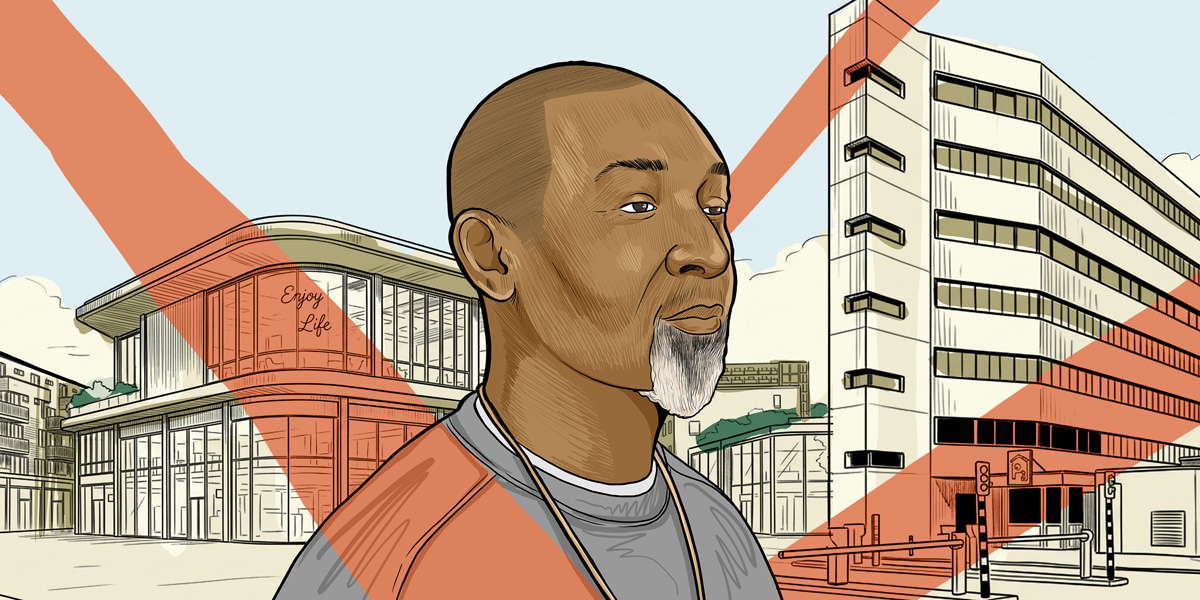
John Agesilas moved to Amsterdam-Zuidoost at the age of fifteen and has since lived in several parts of the district, from Reigersbos and Gein to Strandvliet and Ganzenhoef. Today, he is director of Stichting Foundation (Amsterdam Hip Hop Centre). ‘The strength of Zuidoost isn’t just in its well-known venues and the stadium,’ he says. ‘For me, it’s first and foremost in the people and cultures that give the area its unique character.’
As Zuidoost grows and evolves, he sees an important challenge: making sure the culture that is already here isn’t pushed aside. John believes local creators and organizations need permanent, affordable spaces if they are to grow with the area. That also has implications for the future of his own organization. ‘Foundation is one of the places that shows how a culture of our own has grown here organically, rather than being brought in from somewhere else. Without places like this, transformation can quickly turn into displacement.’
A destination in its own right
Anyone who knows Zuidoost only for the Johan Cruijff ArenA, Ziggo Dome, and AFAS Live has seen only a small part of what the area has to offer, John says. He points to Amsterdamse Poort and the area’s broad cultural scene. ‘You can see and hear Zuidoost’s incredible diversity in its music, dance, art, and sports. That’s something we need to preserve.’
‘You can see and hear Zuidoost’s incredible diversity in its music, dance, art, and sports. That’s something we need to preserve.’
What is still missing becomes especially apparent after 6 p.m. John would like to see more restaurants and cafés, a wider variety of places to eat, more nightlife venues, and a theater. For him, this is about more than simply expanding the range of amenities. ‘It also determines whether visitors head home after a game or concert, or stay and discover Zuidoost as a destination in its own right.’
Culture as the driving force
When it comes to creating those amenities, John doesn’t believe Zuidoost needs to reinvent its identity. ‘Let the local culture be the driving force,’ he says. He points to Surinamese, Antillean, and West African cuisine, as well as the district’s deep roots in hip-hop and dance. ‘A cultural center, food market, or heritage trail can give people a reason to come to Zuidoost without needing a ticket to a game or concert.’
Above all, he sees a need for more places where local talent can develop. Zuidoost has plenty of large venues, but far fewer smaller clubs and performance spaces. In his view, affordable space for creators can help attract audiences while keeping Zuidoost’s cultural identity visible. He sums up the principle clearly: ‘Put residents front and center. Don’t use them as a backdrop.’
An anchor in urban development
John wants Foundation to become a lasting anchor in Zuidoost’s development. He explicitly sees hip-hop as part of the area’s cultural heritage. ‘We can help document and pass on the history of hip-hop in Zuidoost, so those stories aren’t lost as the physical environment changes.’
‘Put residents front and center. Don’t use them as a backdrop.’
He therefore sees Foundation not only as a place where young people are introduced to hip-hop, but also as a place where they can continue to grow and develop. He envisions a path that can start at an early age: a six-year-old might eventually become an instructor, battle champion, producer, or scholar.
That exchange goes both ways, he emphasizes. ‘Our talent naturally has ambitions that extend far beyond Zuidoost. At the same time, we want to bring the world to Zuidoost through competitions and international connections.’
Hardware and software
John also has a clear view on how Zuidoost should be developed if its local culture is to be preserved and strengthened. He believes developers, the municipality, and cultural organizations need to work more closely together and make clearer commitments.
As an example, he points to plans for a new hip-hop venue. He believes the plans address the physical space, but not yet what will actually happen inside it. ‘Don’t just focus on the hardware. Think about the software too,’ John says. ‘A building alone doesn’t create a cultural destination. The programming, opportunities for local talent, and connection to Zuidoost matter just as much.’
Long-term space, not temporary solutions
The same principle applies to the broader development of Zuidoost. If new buildings and new visitors become the overriding priority, John believes the very things that make the area distinctive could be lost in the process. That’s why he wants residents involved in development from the outset. ‘Don’t talk about the neighborhood. Talk with the neighborhood.’
‘A building alone doesn’t create a cultural destination. The programming, opportunities for local talent, and connection to Zuidoost matter just as much.’
His most important message, however, is that local culture and community need permanent, secure space. ‘No temporary leases or incubator spaces that disappear as soon as the surrounding area develops further. We need affordable spaces with leases of at least ten years, and ultimately even opportunities for organizations to own their own spaces.’
For John, this is about more than real estate. ‘If you want Zuidoost’s culture to remain part of the area, you also have to give the people and organizations that sustain that culture the security they need to stay.’