Amsterdam-Zuidoost | Working
‘Zuidoost is growing into an innovation district for Life Sciences & Health’
Emile Spek | Amsterdam UMC
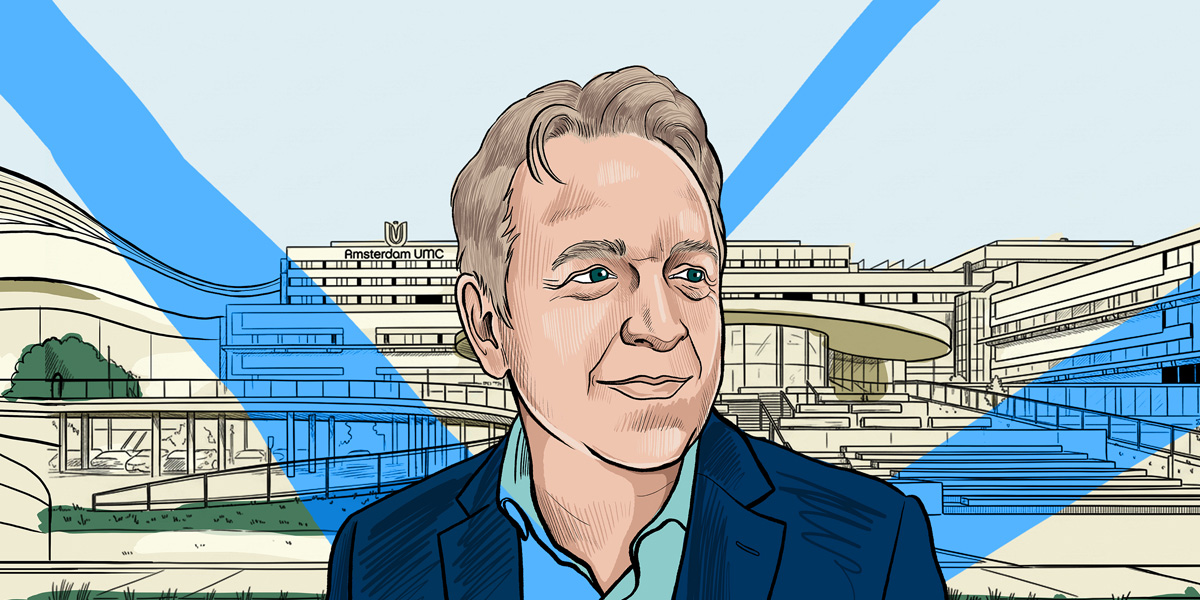
As director of area and campus development at Amsterdam UMC, Emile Spek has a front-row seat to the transformation of Amsterdam-Zuidoost. Around the hospital, a Life Sciences and Health innovation district is taking shape, bringing together research, technology, and entrepreneurship in an ecosystem where they can reinforce one another. That development will soon have a new name: Amsterdam Innovation District Zuidoost. ‘This has long since become much more than just the place where the hospital is located. It’s an increasingly strong ecosystem,’ he says. ‘The new name reflects that transformation.’
The district encompasses the Amsterdam UMC site and approximately fifty hectares between Meibergdreef and the A9, making it one of Amsterdam’s largest innovation clusters. For Emile, this growth didn’t happen overnight. The combination of healthcare, research, knowledge transfer, and education has been attracting new organizations to the area for years.
The results are already visible. In less than a decade, rents in the district have risen from less than €50 to more than €200 per square meter. International companies such as uniQure, Sanofi, Novartis, AstraZeneca, and Stryker have established a presence in the area. ‘We’re seeing an enormous draw.’
International appeal
In Emile’s view, Zuidoost’s strength lies not in any single organization or building, but in the ecosystem as a whole. ‘Companies don’t come here just for the hospital. They come for the combination of expertise, talent, research, amenities, and accessibility the area offers,’ he emphasizes.
‘This has long since become much more than just the place where the hospital is located. It’s an increasingly strong ecosystem.’
That is also driving Zuidoost’s growing international appeal. For researchers, healthcare professionals, and companies, the area is a natural place to establish themselves, thanks in part to its connections to Schiphol Airport and central Amsterdam. ‘Great accessibility, an exciting city, and excellent amenities. That’s what attracts people.’
Still, Emile believes that Zuidoost’s transformation continues to be underestimated in parts of the Netherlands. While Dutch organizations sometimes view the area through the lens of the Bijlmer’s past, international companies tend to focus more on the opportunities they see today. He has seen the same dynamic among international investors, some of whom recognized the area’s potential early on.
Innovation depends on housing
For Emile, housing isn’t a by-product of economic growth. It’s a prerequisite for continued growth and innovation. ‘Innovation ultimately comes down to people, and those people need somewhere to live.’
That applies to PhD candidates and international researchers just as much as it does to nurses and other healthcare professionals. Through partnerships with housing providers, hundreds of Amsterdam UMC employees now live close to where they work, and demand for these arrangements remains high.
‘Innovation ultimately comes down to people, and those people need somewhere to live.’
Emile is concerned, however, about housing affordability for healthcare professionals who are early in their careers. ‘If young nurses and other staff can no longer afford to live in or around Amsterdam, it will ultimately affect both the hospital’s ability to operate and the innovation district’s ability to thrive.’
Enough space, but capacity is lacking
According to Emile, there is no shortage of physical space for now. Unlike in many other parts of Amsterdam, there are still opportunities in Zuidoost to let companies grow and to give new developments a place. The biggest threat, he says, lies in infrastructure. Grid congestion is already preventing companies from always having sufficient capacity on the electricity grid. As a result, investments are delayed or organizations choose a different location.
The biggest risk, he says, is infrastructure. Grid congestion is already limiting the amount of electricity available to companies, delaying investments and, in some cases, prompting organizations to choose other locations.
He also points to increasing pressure on the area’s transportation network. As more homes, businesses, and amenities are added, accessibility needs to keep pace. For a hospital, that isn’t just a question of mobility. It can be a matter of life and death: ambulances and other emergency services need to be able to get where they’re needed quickly.
A cluster with international significance
Amsterdam UMC has been part of Zuidoost since the borough was first developed and has built strong ties to the surrounding community, Emile says. That local connection is reflected in its partnerships with schools, housing providers, businesses, and public authorities. As a landowner, Amsterdam UMC also plays a role in the continued development of the innovation district. ‘We don’t see ourselves simply as a user of the area, but as a partner in shaping its future.’
‘We don’t see ourselves simply as a user of the area, but as a partner in shaping its future.’
Looking ten years ahead, Emile sees one of the Netherlands’ leading innovation clusters taking shape: a district where medical research, technology, fintech, and AI come together, and where international companies and talent connect and collaborate. But he sees one crucial condition for realizing that vision. ‘Growth needs to be supported by investments in energy infrastructure and accessibility.’
If that happens, Zuidoost will be well positioned to realize its full potential. ‘Zuidoost has the space, the ecosystem, and the appeal. The real question is whether the infrastructure can keep pace with its growth.’