Amsterdam-Zuidoost | Working
‘The reputation of Zuidoost has not caught up with reality'
Boudewijn Ruitenburg | Edge
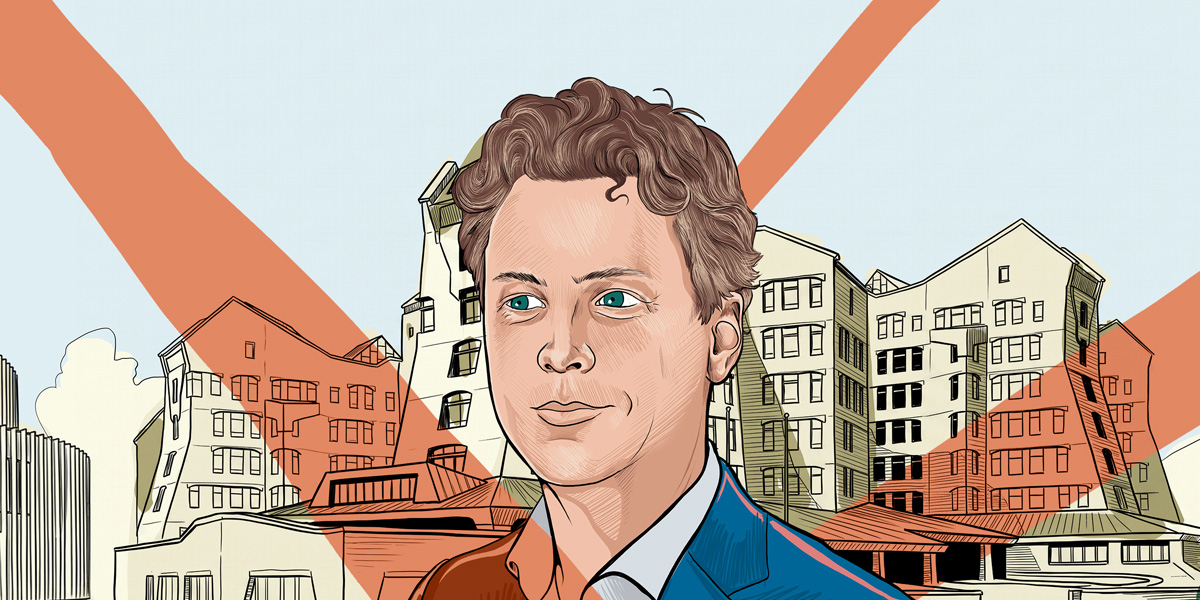
For nearly thirty years, Boudewijn Ruitenburg, CEO of Edge, has followed the evolution of Amsterdam-Zuidoost with great interest. First as a young geographer fascinated by the history and development of the Bijlmer, and later as a real estate professional witnessing the district’s evolution firsthand. What stands out to him most today is that the area's reputation has not kept pace with reality. ‘There is a gap between the quality of Zuidoost and the way the market perceives it.’
He sees this clearly reflected in residential property values and commercial real estate valuations. According to Boudewijn, values remain significantly lower than in other parts of Amsterdam, despite comparable quality. As the area continues to grow and gain more urban functions, he expects this gap to narrow. But that won’t happen on its own, he emphasizes.
The rational alternative
Boudewijn’s fascination with Zuidoost began early. During his studies, he learned about the Atlas complex, a project that had weathered multiple real estate cycles and became a symbol of the area's dynamic character. When he started his first job in Amsterdam in 1998, he traveled daily to Zuidoost and closely observed its transformation.
‘Zuidoost is the rational alternative.’
As a geographer, he enjoys viewing cities through a broader economic lens. In his view, Amsterdam owes much of its success to Schiphol Airport and the city's strong international connectivity, which attract businesses and talent. Within this urban hierarchy, Zuidoost has secured a unique position. Infrastructure projects such as the Utrechtboog rail connection helped create a powerful economic corridor linking Utrecht, Zuidoost, Amsterdam South and Schiphol.
That is why he describes Zuidoost as ‘the rational alternative.’ The area is conveniently located for employees commuting from Gooi, Amstelveen and Utrecht, offers excellent accessibility, and remains considerably more affordable than Amsterdam South or the city center. According to Boudewijn, this combination of location and affordability underpins the area's continued growth. Ultimately, location is the deciding factor for him. ‘There simply is no better place.’
Critical mass
When Boudewijn started working in Zuidoost in the late 1990s, living and working functions were strictly separated. During the day the area filled with office workers, but outside business hours there was little activity. ‘You had a residential world and a business world, but nothing in between.’
Since then, he has witnessed a profound transformation. The arrival of the Johan Cruijff ArenA, the growth of leisure facilities, new restaurants and cafés, and a rising number of residential developments have created what he describes as critical mass. For the first time, Zuidoost has become a multifunctional urban district where people not only work, but also live, meet and spend their leisure time.
‘A true city is not created simply by adding buildings.’
A significant turning point was the decision by major organizations such as ING and ABN AMRO to establish a strong presence in the area. Their arrival generated economic momentum and strengthened the connections between businesses and the surrounding neighborhoods. In his view, this marked an important stage in Zuidoost’s coming of age.
Success is not guaranteed
Being optimistic about the future of Zuidoost does not mean taking success for granted. Boudewijn sees several challenges that could slow the area's development.
According to him, the biggest obstacles do not lie within the district itself, but in the broader system around it.
‘Grid congestion plays a role, but leasehold policies, land pricing policies and lengthy permitting procedures are the issues that often cause projects to stall for years,’ he explains. ‘As a result, valuable time is lost while demand for housing and high-quality workspace continues to grow.’
A vibrant street life
He also emphasizes the importance of the human scale. Wide roads, monotonous ground-floor façades and deferred maintenance can quickly affect how people experience an area. That is why he places great value on vibrant street life, quality hospitality venues, diverse building frontages and public spaces that remain clean, well-maintained and safe. ‘A true city is not created simply by adding buildings, but by paying attention to the experience at street level.’
‘Success will not happen by itself; we all need to keep actively contributing to its development.’
He also sees significant opportunities to improve the quality of existing buildings. Many office properties were developed in a period when efficiency was the primary objective. Tenant expectations have since evolved, increasing the need for modernization. ‘Rising construction costs are making new developments increasingly complex. As a result, refurbishing existing buildings, particularly in prime locations, is becoming more attractive.’
Building the next phase
Through the acquisition and redevelopment of nieuwAmsterdam, Edge is also seeking to contribute to the next phase of Zuidoost’s growth. Boudewijn explains that the decision to invest in the building was, first and foremost, a decision to invest in the location. Situated directly next to Amsterdam Bijlmer ArenA Station, the site combines accessibility, amenities and sustainability.
Beyond renovating the building itself, Edge is focusing on improving the quality of the ground floor and enhancing the area's vibrancy. In his view, these elements help transform a well-connected office district into an attractive urban environment.
Overall, he remains highly optimistic about the future of Zuidoost because its foundations are exceptionally strong. Yet he also sees a risk in that confidence: ‘Zuidoost has everything it needs to continue growing into a leading urban district, but it will not happen by itself. We all need to keep actively contributing to its development.’