Amsterdam-Zuidoost | Leisure
‘Zuidoost is a treasure chest you need to open completely’
Graziëlla Hunsel Rivero | ZOJazz Stage
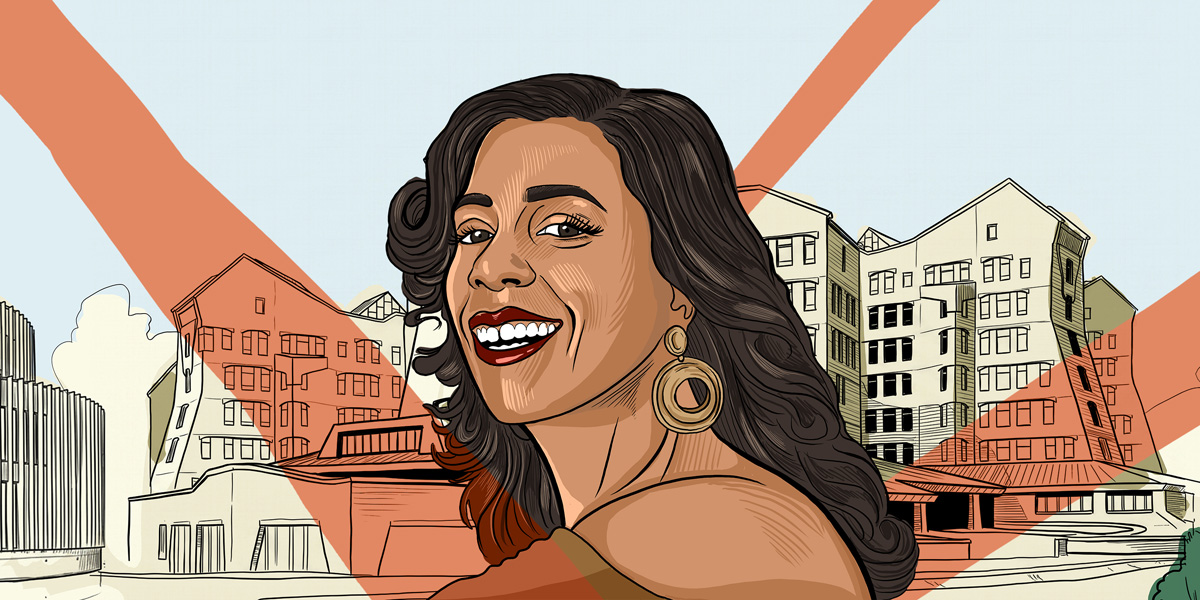
Graziëlla Hunsel Rivero, founder of ZOJazz Stage, sees Amsterdam-Zuidoost as a borough full of musical and creative talent, entrepreneurship and cultural diversity. According to her, the challenge isn’t to add those qualities from outside, but to see what is already there and give people room to develop it further. ‘Zuidoost is a treasure chest, but you have to open it completely to show everything that’s inside.’
Graziëlla puts that conviction into practice daily. For her, ZOJazz Stage began years ago with the realization that Zuidoost has a rich jazz tradition but no stage of its own. In 2011, she therefore started monthly jazz evenings. The wish for a permanent venue remained, but finding the right space proved far from easy.
Start with the people
The breakthrough came when she met Robert Kohsiek, director of Wonam. Their collaboration didn’t begin with a lease or an available ground-floor space, but with a shared vision. At Zandkasteel, Graziëlla was given the freedom to design the space around the function of the stage.
‘So it didn’t start with the building,’ she says. ‘It started with people who pictured the same thing and then looked at: what do we need to make that possible?’ She would like to see that order more often in the area development of Zuidoost. According to her, residents and entrepreneurs have a great deal of professional knowledge and ambition.
Developers who talk with them early on therefore discover not only potential tenants, but also get ideas for a use that genuinely fits the surroundings. ‘Ask what they want to build and then look for the space that fits, instead of first creating square meters and then looking for someone to fill them.’
Not a pop-up, but an anchor
Graziëlla doesn’t see temporary space as a structural solution. An entrepreneur who can stay somewhere for two years and then has to start over hardly gets the chance to build an audience, a network and a healthy business. ‘The borough has had enough pop-ups; now we need permanent anchor points.’
ZOJazz Stage was set up on that principle as a lasting cultural venue. The stage at Zandkasteel consists of a rehearsal space, a smaller performance space and a concert hall. ZOJazz Stage is open seven days a week. The strong response to the crowdfunding campaign that made all this possible confirmed for Graziëlla that the need was shared by the community. ‘This is for everyone. This belongs to everyone.’
The programming deliberately draws on the enormous cultural diversity of Zuidoost. Graziëlla also works with partners such as Bimhuis, Grachtenfestival and international jazz networks. Her ambition is big: ZOJazz Stage should ultimately mean to Zuidoost what Bimhuis means to Amsterdam.
Doing business must actually be possible
Graziëlla sees the current construction activity in the area as an exceptional opportunity to make local entrepreneurs and cultural organizations a lasting part of the future Zuidoost. ‘But simply reserving square meters isn’t enough. The financial conditions ultimately determine who can actually get in.’
That is where it often chafes, she says. When high market rents are built into the business case for new commercial spaces early on, it becomes difficult for small and creative entrepreneurs to realize a viable concept there. The space may come, but not automatically for the people who give the area its character. ‘If only chains can afford it, you end up with the same thing everywhere.’
Graziëlla sees entrepreneurship that grows out of the culture of Zuidoost as an important reason for people to visit the area. ‘So don’t just make room for local entrepreneurs on the map, make sure they can actually do business there.’
The DNA remains Zuidoost
In Graziëlla’s view, the new neighborhoods may develop a character of their own, but that doesn’t mean they become detached from the existing borough. She stresses that new developments still belong to postal code area 1101 and therefore to Zuidoost. ‘We’re upholding who we were and who we are. Everyone who is new is welcome to join in.’
That calls, she says, for curiosity from developers about the people who already live and work there. Not only researching which commercial formula fits on paper, but going into the neighborhood and discovering which entrepreneur, maker or professional is ready to take the next step.
Excellence from the Bijlmer
Graziëlla’s conviction is personal, too. She was born and raised in Zuidoost and remembers the Bijlmer of her youth as a green paradise where you could grow up in freedom as a child. Only when she later went to secondary school in Amsterdam-Zuid did she discover that others looked at her part of the city very differently. That experience became a driving force for her to show that quality did come out of Zuidoost and that it could also find a place in what was, to her, a new ecosystem.
Zuidoost is growing, and in ten years there will be more buildings and amenities. She hopes that the people who have lived in Zuidoost for generations will be a visible part of the borough’s success. ‘We should all realize that the people of the Bijlmer are excellent in their own way, that together with the various stakeholders in the area we can make the change and build our own part of Amsterdam with the unique DNA of Zuidoost.’