Amsterdam-Zuidoost | Area Development
‘Amsterdam Southeast Should Not Become a Copy of the Zuidas’
Richard Stolle | Stadium Capital Partners
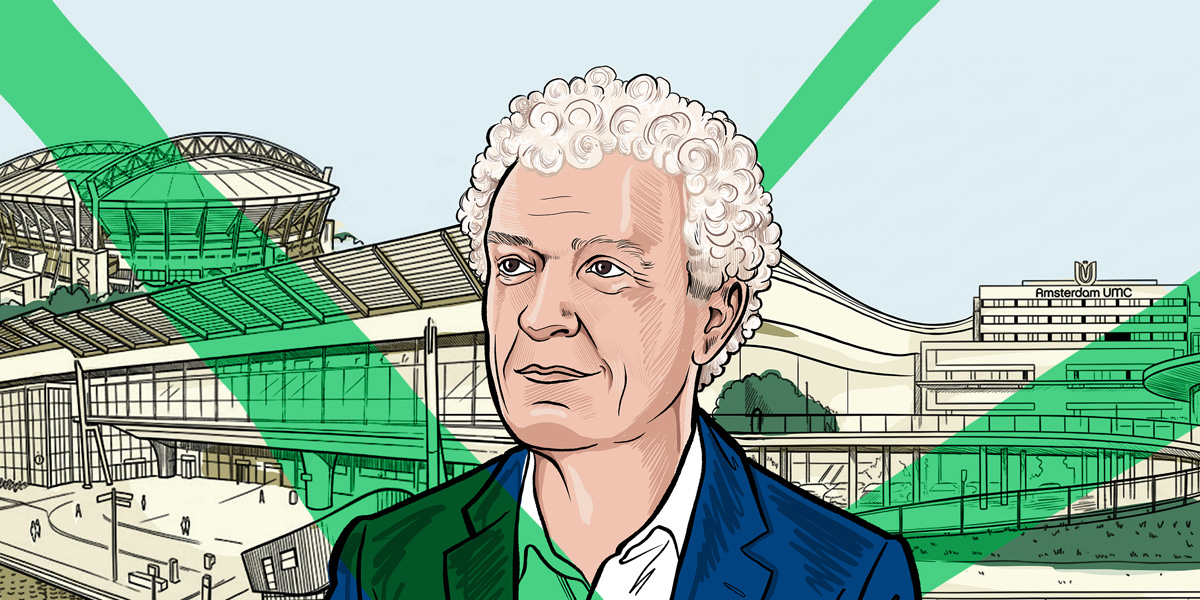
In Amsterdam-Zuidoost, Stadium Capital Partners is developing Ventura City, a major urban transformation project located near the Johan Cruijff ArenA and ArenAPoort. With a contiguous landholding of 31 hectares, the real estate investor occupies a unique position in the area's redevelopment. ‘This scale allows us to think beyond individual buildings,’ says founder and managing partner Richard Stolle.
Ventura City is envisioned as a mixed-use urban district where living, working, learning and leisure come together. The first phase will include approximately 2,500 homes, with a strong focus on students and young professionals, as well as one of Amsterdam’s first multi-story commercial buildings. The development will also accommodate sports facilities, educational institutions, businesses and hospitality venues. Plans further include a new urban park and a campus focused on artificial intelligence.
‘Zuidoost has everything it needs to become a new urban center, with a distinct identity of its own.’
According to Richard, the project’s ambitious nature reflects the potential of the wider area. ‘Zuidoost has everything it needs to become a new urban center, with a distinct identity of its own. It should definitely not become a copy of the Zuidas. There is no need for that, and it simply would not fit this place.’
A changing image
Richard currently sees Zuidoost as an outdated business district where offices and leisure facilities still dominate. In his view, the opportunity lies in introducing a broader mix of functions, particularly housing. That also means overcoming long-standing perceptions. ‘Unfortunately, living in Zuidoost is still associated with outdated views of the Bijlmer from the past.’
At the same time, he sees clear signs that perceptions are changing. He points to the SPOT residential development, where homes are being sold for around €6,000 per square meter. The area’s strong connectivity also works in its favor. ‘There are multiple train and metro stations, always within walking distance. You can easily reach other parts of the city. But ideally, there should be no need to travel elsewhere for your daily needs.’
Zuidoost benefits from generous public spaces, a strong green infrastructure and a unique location alongside the green Amstel corridor, with its river landscapes, polders and open countryside. According to Richard, these landscape qualities provide significant added value for future urban development.
A new city
Richard therefore advocates applying the principle of being ‘always complete’: the key elements of daily life should be present throughout the area. He cites sports facilities, playgrounds, supermarkets and GP practices as examples.
‘If you combine affordable housing for young talent with new jobs in growth sectors, you have a winning formula.’
He also wants to bring living and working closer together. Alongside new housing, Richard is developing an AI campus within Ventura City to attract new forms of employment to the area. According to him, this combination distinguishes Zuidoost from other urban districts. ‘If you combine affordable housing for young talent with new jobs in growth sectors, you have a winning formula.’
Furthermore, Richard sees a major advantage in attracting students and young professionals as the area's first residents. From the outset, they can help create street life and support demand for new amenities. ‘Once that first momentum starts, the neighborhood, the ground-floor spaces and the resident mix can gradually continue to evolve.’
Ground floors play a key role
According to Richard, the ground floors of buildings will play a decisive role in shaping the area. ‘They are essential to how people experience a neighborhood. This is where residential entrances, shops, supermarkets, creative businesses and cultural venues come together,’ he says. ‘Nightlife should also be part of the mix.’
Yet, vibrancy cannot simply be planned on paper. That is why he wants to attract entrepreneurs who can create activity and character from the very beginning. ‘A bicycle shop that serves as a meeting point for cyclists heading out, a coffee bar or a great restaurant may seem like small components of a development, but they can have a huge influence on how a place is experienced.’
‘It is not just about square meters; it is about the quality of the neighborhood that is created from day one.’
At the same time, ground-floor spaces must be allowed to grow gradually alongside population growth. ‘You cannot burden new entrepreneurs with high rents from day one. They need time and space to establish themselves.’
One chance to get it right
The lessons of the original Bijlmer still influence Richard’s perspective on the future of Zuidoost. In his view, a large-scale development area such as this has only one chance to get things right. Poor decisions regarding management, amenities or the programming of ground-floor spaces can have long-lasting consequences. ‘It is not just about housing numbers or square meters. It is about the quality of the neighborhood that is created from day one.’
Looking ahead ten years, Richard hopes to see a district that is truly alive: a place with activated ground-floor spaces, a thriving nightlife scene and residents who have consciously chosen Zuidoost as their home. ‘Only when there is activity here at every moment of the day can we truly call the development a success.’