Amsterdam-Zuidoost | Leisure
‘Give Southeast’s rich culture room to grow’
Marian Duff | OSCAM
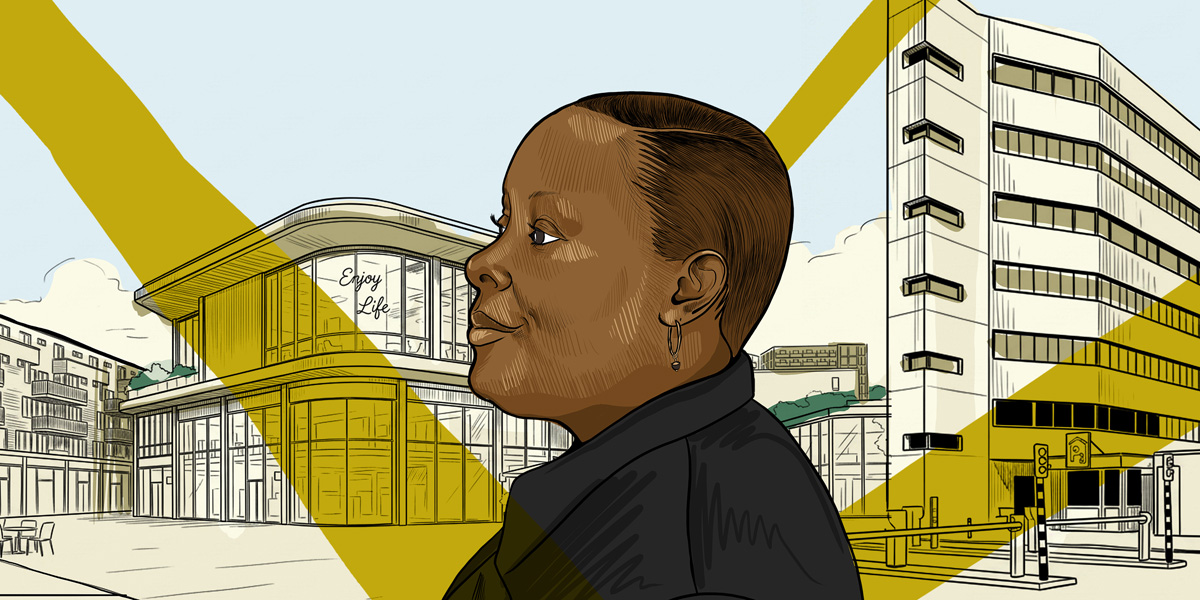
Marian Duff has been a cultural entrepreneur for 30 years, 25 of them in Amsterdam Southeast, including as founder and director of OSCAM (Open Space Contemporary Art Museum). Over the years, she has watched a cultural network emerge from within the community that is far larger than many outsiders realize. On the residential side of the railway tracks alone, she counts more than 21 arts and cultural organizations. ‘Most people have no idea how many arts and cultural organizations are based here.’
That perspective also shapes the way Marian views the development of Southeast. To her, the challenge is not to bring culture into the district, but to preserve space for what has already been growing here for years. ‘Set aside square footage where a generation of arts and cultural entrepreneurs can build and develop for the long term.’ Using culture temporarily to make an area more attractive does not create a lasting cultural infrastructure, she argues.
Culture grows from the ground up
Marian describes Southeast as a place where new ideas often take shape early. Art, fashion and literature are tested and developed here before finding their way to central Amsterdam and beyond. That reflects how she sees the district: ‘This isn’t a place with a cultural deficit. It’s an area with a cultural strength of its own.’
‘Set aside square footage where a generation of arts and cultural entrepreneurs can build and develop for the long term.’
Much of that strength is built from the ground up. Arts and cultural organizations across the district are becoming more visible, collaborating more frequently and strengthening their position. To Marian, that matters because it demonstrates that the cultural foundation does not need to be created through real estate development. ‘It’s been here all along.’
The world of Southeast
Through OSCAM, Marian focuses on art, fashion, design and craftsmanship, primarily providing a platform for young, undiscovered artists. In doing so, she aims to connect ‘the world of Southeast’ with other parts of Amsterdam. OSCAM has worked with organizations including Amsterdam Fashion Week, Amsterdam Museum, Buro Stedelijk and Museum van Loon.
International artists have also been connected with stories from the local community. Ghanaian-British artist Bevan Agyemang, for example, led workshops with residents and incorporated their stories into garments that were later presented during Amsterdam Fashion Week. ‘We really try to create connections starting from the very fabric of Southeast.’
From placemaking to placekeeping
In urban development, Marian sees an important distinction between placemaking and placekeeping. Temporary cultural programming can make a place more attractive, but that does not mean the people who helped create that appeal will ultimately be able to remain there. ‘First, that’s a waste of investment. And second, it doesn’t strengthen the position of the people who are already here.’
‘Southeast isn’t a place with a cultural deficit. It’s an area with a cultural strength of its own.’
That is why she argues for a much longer time horizon. Rather than giving an artist or cultural initiative a space for two years and then starting over, she wants physical space to be made available where an entire generation can develop and put down roots. The issue is becoming more urgent as affordability comes under pressure. ‘We’re running out of square footage, here in Southeast too.’
For a district growing on this scale, Marian believes a mature cultural infrastructure should be part of the equation. ‘When a district grows to the size of a city, it deserves arts and culture at a level that matches that scale.’ That requires more than physical space. It also means funding and zoning plans that give cultural uses a permanent place.
Building connections takes time
Space alone is not enough. Marian sees different worlds within Southeast that still have relatively little interaction. The office and entertainment areas have a very different daily rhythm from the residential neighborhoods. Creating meaningful connections between them takes more than bringing everyone to the same community engagement meeting once.
She has experienced firsthand how much time genuine relationships can take. For two years, she met with OSCAM’s property owner every Monday. Those conversations went beyond rent and business agreements; the goal was to truly understand each other. ‘That’s the foundation you can build on together. But if all you’re doing is striking a deal based on a lease, you never really get to know each other.’
Growing without leaving people behind
The growth of Southeast creates many opportunities, Marian says, but it also raises a fundamental question: will the people who helped shape the district benefit from what is now being created? She sees new residents with greater financial resources moving into Southeast. ‘That doesn’t have to be a problem, as long as the people who already live here continue to be seen and heard.’
‘Growth doesn’t have to mean that cultural initiatives are pushed out as soon as real estate becomes more valuable.’
The same principle underpins her argument for placekeeping. ‘Growth doesn’t have to mean that the cultural initiatives that give an area its character are pushed out as soon as real estate becomes more valuable. When a neighborhood becomes more attractive, that is precisely when we need to think about the position of the people and organizations that have invested years in building it.’
For Marian, OSCAM demonstrates how different worlds can exist side by side without one being treated as more important than the other. ‘In 2020, we displayed an original Rembrandt next to work by local artist AiRich, literally at the same height,’ she says. ‘Not to elevate the local work through its proximity to the Rembrandt, but because both deserve their place.’
A place to stay
Fifteen years from now, Marian hopes arts and culture will have a more permanent position in Southeast: more physical space, adequate funding and zoning plans that prevent cultural uses from having to fight for their place over and over again.
She believes that shift has already begun, but continuity will be essential to ensure that the structures being built today do not disappear again tomorrow. For Marian, that is ultimately what urban development is about: creating a district where young professionals can develop and thrive, while also having a reason and the space to stay.