Amsterdam-Zuidoost | Working
‘Keep up the pace, but be willing to adapt along the way’
Jurriaan Snijders | Flow Real Estate
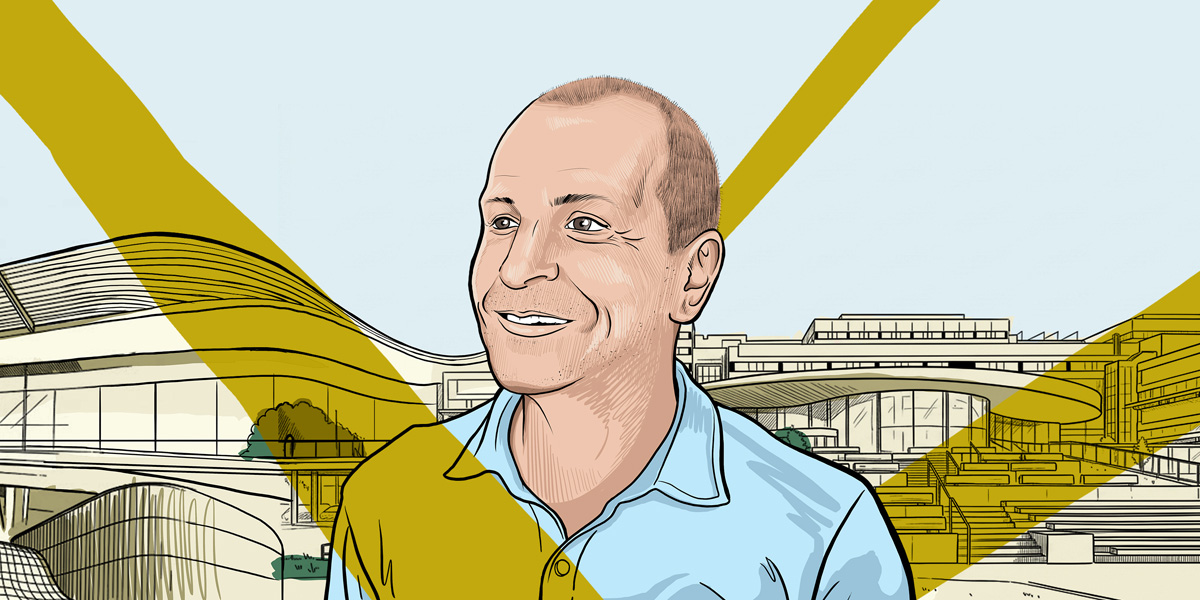
Jurriaan Snijders, partner at FLOW Real Estate, sees Amsterdam-Zuidoost changing rapidly. As a developer, he has been active in the area for years and has seen firsthand both what that momentum makes possible and where plans can run into obstacles in practice. For him, the most important lesson isn’t to plan even further ahead. ‘When developments take years to complete, you need to leave enough flexibility to respond to changing circumstances along the way.’
That applies to the balance between housing and offices, but especially to the types of housing being planned. What makes sense today may look very different by the time a project is completed. That experience shapes his approach to new developments in Zuidoost: keep up the pace, but don’t lock plans in so tightly that there’s no room to adapt.
Not the same everywhere
Jurriaan sees how important it is to look at each location on its own merits. ‘Offices perform well around the station, while demand can already be considerably weaker just a few minutes’ walk away,’ he says. ‘Even a high-quality building can struggle to attract tenants in those locations.’
‘I’m not arguing for open-ended agreements. I’m arguing for agreements flexible enough to remain workable over the many years it takes to develop an area.’
That’s why he believes the same mix of uses won’t work everywhere in Zuidoost. Close to the station, he sees a strong future for high-quality office space. Farther out, there may be more potential for different office concepts or housing.
Green heart
Looking five to ten years ahead, Jurriaan envisions an area where those differences are more clearly defined: offices around the station, a different mix of uses toward Atlas and Plaza ArenA, and higher-density housing in Amstel III, with Hondsrugpark at its green heart.
He says that location-specific approach can sometimes conflict with existing regulations. For example, he questions the requirement to replace demolished office space on a one-for-one basis, even in locations where there is little demand for offices.
Planning years ahead
Jurriaan sees a similar challenge in housing development. Developers have to decide early on what types of homes to build and at what price points, even though many years can pass between the planning stage and completion. By the time those homes actually reach the market, demand may have shifted. ‘It can easily take seven or eight years to go from initial concept to completion.’
‘What matters most to me is achieving the right long-term balance across housing segments, including room for higher-end housing, without requiring every individual project to deliver that entire mix.’
At The Hills, that challenge became very real. One of the three towers, comprising 233 mid-market rental units, ultimately couldn’t be sold as originally planned. The housing mix was therefore adjusted to include both social and mid-market rental units. De Alliantie subsequently acquired Tower 1, consisting entirely of social housing, and Tower 2, with a mix of social and mid-market rental units.
Jurriaan is applying that experience to his project on Hettenheuvelweg. There, the plans allow for ranges within the housing mix, leaving more flexibility to respond to market demand later in the development process. For him, that flexibility is crucial. ‘I’m not arguing for open-ended agreements. I’m arguing for agreements flexible enough to remain workable over the many years it takes to develop an area.’
Maintaining momentum
For Jurriaan, speed is one of Zuidoost’s greatest strengths. Comparing it with other transformation areas, he sees tangible progress being made here. He notices it almost every day when driving along the A9. ‘You see all the cranes and how much is being built here.’
He doesn’t want to lose that momentum. In his view, rules and agreements need to leave enough flexibility to keep projects viable as circumstances change. And that flexibility needs to extend beyond individual developments. ‘What matters most to me is achieving the right long-term balance across housing segments, including room for higher-end housing, without requiring every individual project to deliver that entire mix.’
‘Keep Zuidoost’s long-term vision in sight, but don’t let decisions made years in advance close off the paths that could get you there.’
That also requires collaboration between property owners and the municipality. In developing plans for the area south of The Ensemble, FLOW Real Estate worked with other owners and KCAP on a broader urban development vision. Not every initial idea proved feasible, but the process did encourage everyone involved to look beyond their individual projects and consider how the area works as a whole.
New constraints on growth
Even with flexible plans, new constraints can emerge. Grid congestion is becoming an increasingly important factor in investment decisions. When considering new acquisitions, Jurriaan now looks at the available grid capacity from the outset. ‘Without sufficient capacity, a development can quickly become difficult to deliver.’
He also sees challenges around parking and the municipality’s capacity to support development. Expensive parking facilities can make housing projects less financially viable, he says, while shared solutions could help unlock and accelerate development elsewhere. That brings him back to the same principle: ‘Keep Zuidoost’s long-term vision in sight, but don’t let decisions made years in advance close off the paths that could get you there.’