Amsterdam-Zuidoost | Living
‘Amstel III is becoming a neighborhood of its own’
Randy van den Broek | COD
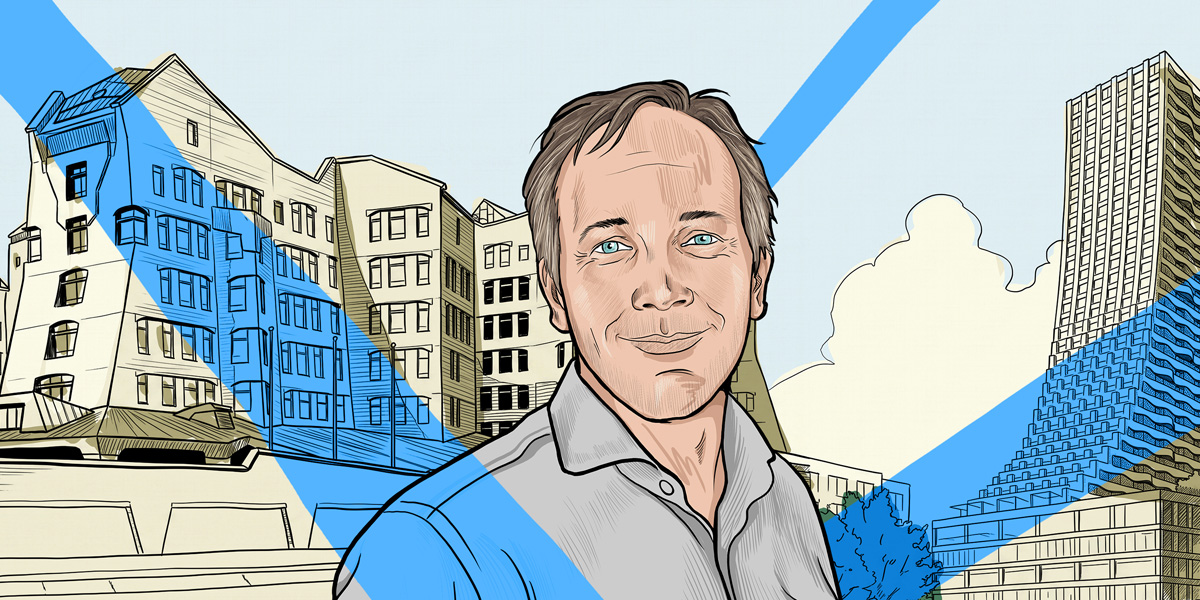
As the developer behind SPOT, a large-scale new development and redevelopment project, Randy van den Broek has had a front-row seat to the transformation of Amstel III for years. The director of development at COD is watching a single-use office district evolve into a place where people live as well as work.
That transformation is moving faster than he initially expected. Along the way, his vision of the finished neighborhood has changed as well. ‘Amstel III doesn’t need to blend into the rest of Amsterdam-Zuidoost to succeed as an urban neighborhood,’ he says. ‘It’s becoming a distinct part of the city in its own right.’
In Randy’s view, the strength of Zuidoost lies precisely in the different worlds that have long existed side by side here. They range from the cultural identity and green spaces of the Bijlmer to the stores, entertainment venues, office districts and new residential developments on the other side of the train tracks. Treating the borough as a single, cohesive whole overlooks how the area actually functions today, he argues.
A collection of urban islands
The ArenA district, Amsterdamse Poort in Bijlmer-Centrum, Bijlmer-Oost and the H neighborhood, and Amstel III in Bijlmer-West each attract a different mix of people. Each has its own character, strengths and dynamics. Each has its own character, strengths and dynamics. That is why Randy describes Zuidoost as ‘a rich collection of urban islands’.
‘Amstel III doesn’t need to blend into the rest of Amsterdam-Zuidoost to succeed as an urban neighborhood.’
The boundaries between them are both visible and tangible. ‘There are changes in elevation, overpasses and walking routes that simply come to an end. You can’t design away or smooth over every one of those barriers.’
For Randy, this points to a broader challenge: Amstel III still lacks a clear sense of orientation. ‘Visitors know how to find the Ziggo Dome and IKEA, but they have very little sense of the streets and routes around them. This entire area was designed around logistics, not wayfinding.’
Urban planning alone will not solve that problem, he believes. The city’s main role should be to build bridges between these islands by providing a clean and safe environment, clearly marked routes, and room for activities and local businesses to establish themselves organically. ‘The entire area should feel like an open invitation to explore other neighborhoods in Zuidoost,’ he says. ‘That’s what I call a city that enables rather than dictates. I don’t believe you can engineer a city from the top down.’
Residents drive vibrancy
True vibrancy is not created by visitors or people passing through, Randy emphasizes. It comes from residents. ‘Office workers arrive and leave again. Residents move through the neighborhood throughout the day. They shop, go out for lunch, walk their dogs and get to know their neighbors. That’s why housing is the engine that drives vibrancy.’
‘I believe in a city that enables rather than dictates. I don’t believe you can engineer a city from the top down.’
That does raise the classic chicken-and-egg question. Residents want more amenities, while business owners need more customers before they can operate profitably. ‘Residents ask, “Where are the amenities?” And business owners ask, “Where are the people?” It’s essential for the two to grow in step with each other.’
A welcome surprise
Through SPOT, COD is playing a major role in Amstel III’s transition to a mixed-use urban district. The development consists of seven buildings with a total of 1,095 rental and owner-occupied homes, complemented by office and commercial space.
Even so, Randy finds that perceptions of Zuidoost continue to make it harder to attract new residents. ‘People don’t automatically come and take a look at an area they know little about, especially when their perception of it is largely shaped by the past. But once they visit, their response often changes. They’re genuinely surprised by what they find.’
‘Residents move through the neighborhood throughout the day. That’s why housing is the engine that drives vibrancy.’
He considers the area’s variety one of its greatest opportunities and believes it deserves far more attention. ‘From Amstel III, you’re close to a major shopping center, entertainment venues, a culturally diverse residential neighborhood and plenty of green space. Where else do you find all of that? Zuidoost is even the greenest borough in the city.’
Not another Zuidas
That realization has also changed Randy’s own vision for the future of Zuidoost. When he first became involved in the area, there was a general ambition for Amstel III to eventually merge with the rest of the borough. Today, he sees a different future taking shape: a neighborhood that stands on its own and functions successfully without every boundary between it and the surrounding districts having to disappear.
He could even see himself living there, particularly because of its accessibility, the variety of nearby amenities and the appeal of living in a neighborhood that is still taking shape. ‘It isn’t a second Zuidas or another city center, and it absolutely shouldn’t be. I’ve been surprised time and again by how much there is to do in Zuidoost and how much the area has to offer. It really is a great place to live.’