Amsterdam-Zuidoost | Leisure
‘Let arts and culture grow along with Zuidoost’
Jolanda Spoel | Bijlmer Parktheater
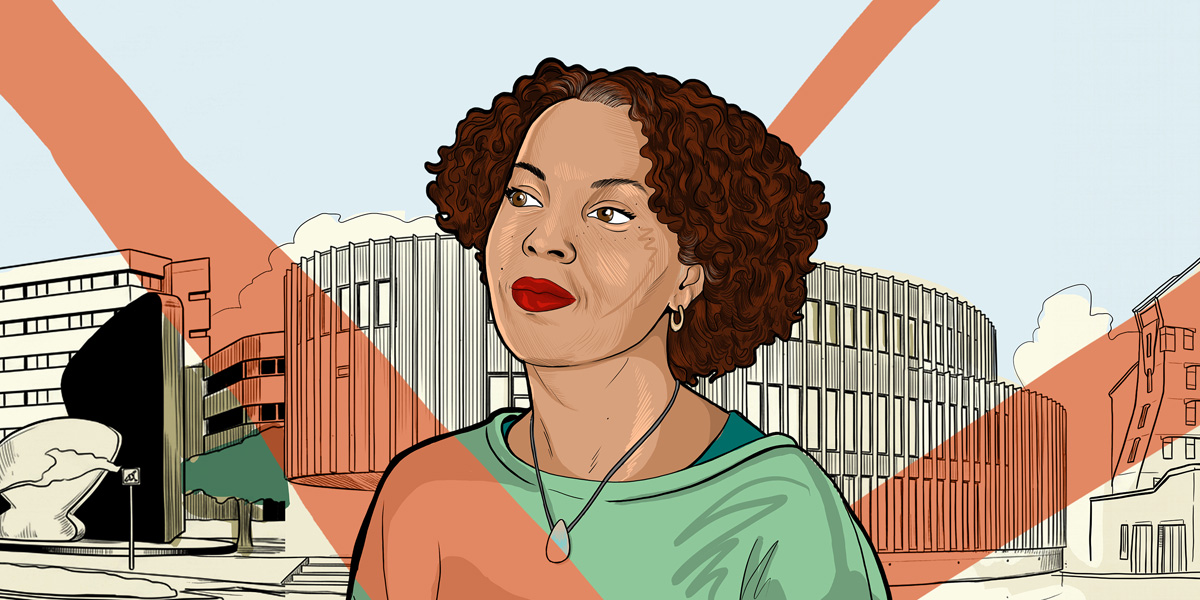
For Jolanda Spoel, general director of Bijlmer Parktheater, the growth of Amsterdam-Zuidoost is about much more than building new homes. Arts and culture need to be part of the area’s development from the outset. She believes the foundation is already there, with more than twenty arts and cultural organizations, but the physical space and long-term support they need have not kept pace. ‘If Zuidoost eventually has a population comparable to Nijmegen’s, we also need to make sure residents have access to a vibrant and fully developed arts and cultural scene.’
That belief is central to how Jolanda thinks about urban development. Arts and culture are still too often brought in afterward, as temporary programming or an attractive way to activate ground-floor space. ‘In urban development, arts and culture are often used for placemaking, but that rarely leads to placekeeping. That doesn’t reflect what the performing arts, visual arts, and talent development actually need, or the value they can bring to a neighborhood over the long term.’
Culture needs a place of its own
Jolanda was once reminded just how easily culture can disappear from development plans during a presentation about the area around Amsterdamse Poort. Local landmarks such as Nelson Mandelapark, the borough office, and new development projects were shown on the map, but Bijlmer Parktheater, which had been there for years, was missing. ‘You could easily see that as a blind spot, or as a sign that culture is still considered secondary in urban development.’
‘If Zuidoost eventually has a population comparable to Nijmegen’s, we also need to make sure residents have access to a vibrant and fully developed arts and cultural scene.’
It later turned out that room for arts and culture had been drawn into the new construction projects: some 2,000 square meters in the ground-floor space. In her view, that approach is exactly how it should not be done. ‘An attractive ground floor is something different from the infrastructure needed for a theater, dance school or arts institution,’ she explains. ‘That is why I argue that in area development, you should first research what cultural organizations actually need and then structurally include that space in the plans.’
The same applies to how leisure is defined. In plans for Zuidoost, she sees a strong focus on sports, including sporting events, and other large-scale events, while the performing arts, visual arts, and nightlife are less consistently part of the picture. As a result, she believes some of the area’s cultural needs are not being met. ‘Why should people have to go into central Amsterdam for that? Why shouldn’t they be able to find it here?’
Distributing investment more fairly
Jolanda’s concerns extend beyond arts and culture. Zuidoost’s rapid growth raises a broader question for her: who actually benefits from all that investment? She sees significant differences between neighborhoods across the district and believes new development should improve the quality of life not only for new residents and visitors, but also for the people who already call Zuidoost home.
For Jolanda, change is not necessarily the same as progress. ‘Neighborhoods can change, and new groups can bring something valuable. But if investment is concentrated mainly around new developments while existing residential neighborhoods are left behind, inequality will only deepen.’
‘In urban development, arts and culture are often used for placemaking, but that rarely leads to placekeeping.’
That’s why she takes a critical view of initiatives designed to create opportunities for residents. It’s not enough to introduce them; you also have to find out whether they’re actually making a difference. ‘Make sure it’s more than an empty gesture,’ she emphasizes.
Talent needs room to keep growing
Jolanda sees every day at Bijlmer Parktheater what happens when cultural infrastructure is available close to home. Around 80,000 visitors come through its doors each year. Every week, more than 500 children and young people take part in classes, workshops, and other development programs offered by Bijlmer Parktheater and the other organizations based there.
In practice, the theater is much more than a performance venue. Programs such as Wereldmakers introduce children to the performing arts, while Talentlab supports young theater makers. Jeugdtheaterschool Zuidoost, dance school We Are On The Move, and UNTOLD also use the theater for their activities. ‘It’s a place where children and young people can discover the performing arts and continue developing their talents.’
Jolanda sees a broader challenge for talent development in Zuidoost. ‘There’s a tremendous amount of talent in the district, but the opportunities and facilities people need to take the next step aren’t always available close to home.’ For her, the ambition therefore needs to go beyond discovering talent: ‘They also need the opportunity to keep growing right here in Zuidoost.’
Securing space for the long term
That requires long-term certainty around cultural space. Jolanda has seen firsthand how fragile that can be. When Pakhuis de Zwijger ended its New Metropolis initiative in Zuidoost, she contacted the building’s owner. Bijlmer Parktheater was then able to use the space for just over a year, but ultimately had to move out again.
For Jolanda, that experience shows why temporary space isn’t enough. ‘If space for arts and culture isn’t formally protected, it can easily disappear, sometimes leaving a building without a new use for a long time afterward.’ That’s why she advocates designating space specifically for arts and culture, along with agreements to provide replacement space when an existing cultural use is displaced.
‘Don’t treat arts and culture as decoration for urban development. See them as essential amenities that help determine whether residents truly feel part of the city taking shape around them.’
She is beginning to see progress on that front as well. A dedicated arts and culture vision for Zuidoost is being developed, along with benchmarks for the cultural infrastructure a district of this size needs. For Jolanda, the real test will be whether that ultimately results in permanent space and long-term funding. ‘I hope this leads to a clear target for the types of cultural spaces and the amount of space we need, one that truly reflects Zuidoost’s ambitions and growth.’
Culture as an essential urban amenity
Jolanda’s greatest wish is for residents to no longer have to travel to other parts of Amsterdam to experience high-quality performing arts. ‘Don’t treat arts and culture as decoration for urban development. See them as essential amenities that help determine whether residents truly feel part of the city taking shape around them.’