Amsterdam-Zuidoost | Working
‘Southeast is not a copy, it tells its own story’
Nathan Smith | KanAm Grund Group
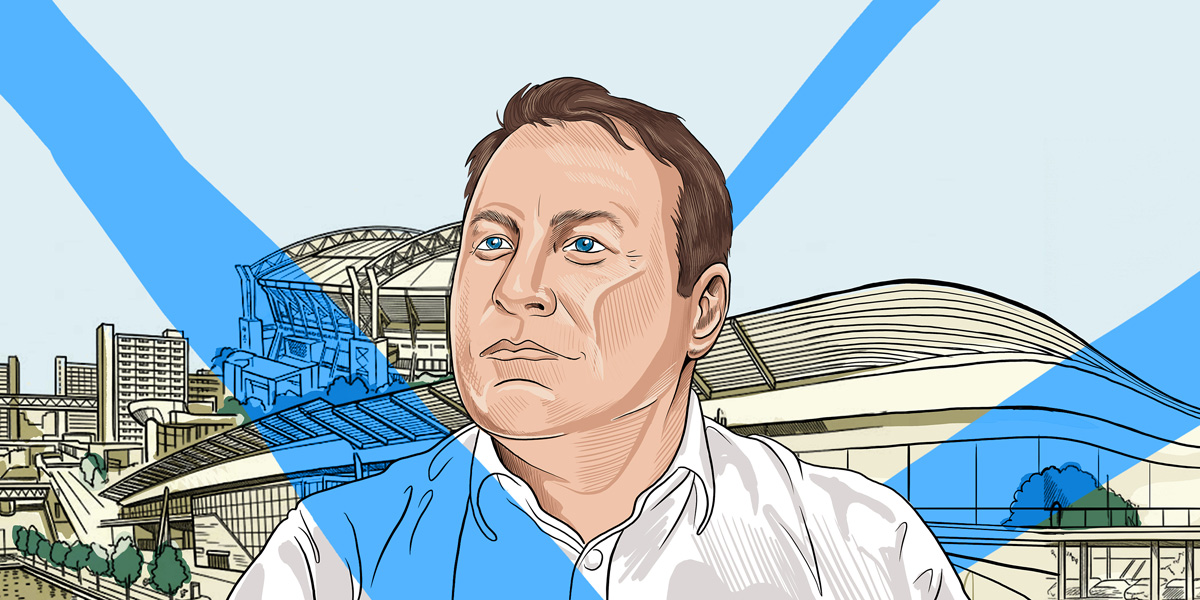
The strength of Amsterdam Southeast lies not in what still has to be built, but in what is already there. So says Nathan Smith, Head of Development Management Europe at German real estate investor KanAm Grund Group. ‘Many urban developments start with one dominant function and then try to add workplaces, housing, hospitality or leisure to it. In Southeast, all the ingredients are already present. It’s a fantastic canvas to work with for the modern investor and developer.’
In his view, the district offers a combination that is hard to replicate elsewhere: an established residential area, a strong office cluster, large-scale leisure facilities and transport infrastructure that has been geared to all of this for years. That makes Southeast attractive to both Dutch and international investors.
This sets the area apart from other well-known development locations. He points to international examples such as Canary Wharf in London, where the commercial function dominated for a long time. He also sees the Zuidas as an area that has been developed largely from an office perspective. ‘Southeast now has the chance to choose a different route and further strengthen the existing mix of functions, rather than looking for balance after the fact.’
‘Work, stay, play’
This ties in with Nathan’s broader vision on real estate. In his view, companies should pay more attention to the quality of the environment in which their employees work, both inside a building and surrounding it. To him, an office is not a standalone accommodation question, but part of a broader strategy around talent, culture and productivity.
‘Southeast now has the chance to choose a different route.’
That is why he prefers to talk about an environment where people can work, stay and unwind. He sees this combination of ‘work, stay, play’ nowhere in the Netherlands as strongly as in Southeast.
‘When employees feel comfortable in an area, come to the office more often and stick around after work, you get more encounters and stronger social connections,’ he says. ‘This drives social cohesion, as reflected in staff retention, boosts productivity, and is becoming increasingly valuable in a world where much of the work takes place digitally.’
You can build the very best building, but if it stands in a place where people don’t feel safe, or where they don’t want to go for a drink after work, then according to Nathan it is still hard to attract staff. ‘Your recruitment costs, your retention costs and the productivity of your employees all suffer.’
Growing without losing balance
Where Nathan sees the biggest opportunity, he also sees the biggest risk. In his view, the success of Southeast depends on its ability to maintain the mix of functions. As soon as the area tilts too far to one side, it risks losing the quality that makes it distinctive.
‘The office environment should not function solely for the tenants of the building.’
He is therefore positive about the role the municipality plays in developing the area. According to him, there is a deliberate focus on balanced growth, so that the most popular real estate category of the moment does not automatically push out the rest. ‘That may make the development less spectacular in the immediate short term, but it makes it more sustainable in the long term.’
Alongside this spatial balance, he also sees practical challenges. Accessibility is an important competitive advantage for the area, but issues such as electricity grid congestion call for lasting cooperation between public and private parties. Only then, he says, can the area keep growing without infrastructure becoming a brake on new developments.
The role of Omnia
Through the development of Omnia, Nathan contributes on behalf of KanAm Grund Group to this broader ambition. The project will not only add high-quality office space but also contribute to the quality of the area as a whole.
The emphasis is on flexibility, sustainability and connection. He talks about spacious floor plates, plenty of greenery and an active ground floor where different user groups come together. ‘The office environment should not function solely for the tenants of the building but also give something back to its surroundings and the people that inhabit them.’
He also sees opportunities in working with other stakeholders. Because offices, leisure facilities and residents have different usage patterns, there are opportunities to share facilities more smartly. ‘Think of issues around parking, mobility or energy,’ he says. ‘By tackling such challenges collectively, the area can become stronger than the sum of its parts.’
More than a cheaper alternative
Although Southeast has changed significantly in recent years, Nathan believes the market does not yet fully appreciate the area’s potential. He points to the relatively low office rents compared with other top locations in Amsterdam. In his view, this is where the growth opportunity lies.
That opportunity is not just about price. ‘A high-quality office environment in an easily accessible location becomes more and more attractive as organisations look more critically at the relationship between their accommodation and their people strategy.’
‘The task for the coming years is mainly to build out those qualities, without losing them.’
He therefore expects appreciation for Southeast to keep growing in the coming years and the gap with other established office markets to narrow. ‘Not because Southeast becomes a copy of those areas, but because it tells a different story.’
An example for the next generation
Looking fifteen years ahead, Nathan hopes Southeast will be seen as an example of what urban redevelopment should look like. Not only in the Netherlands, but beyond. In that future picture, the area’s existing identity remains visible, while new residents, businesses and visitors find their place there.
He certainly does not see himself as a pioneer in this, but as someone building on work that began years ago. In his view, the infrastructure, the businesses that settled there and the community that already lived there formed the foundation. ‘The task for the coming years is mainly to build out those qualities, appropriately for the modernizing world, without losing them.’