Amsterdam-Zuidoost | Living
‘Don’t just develop real estate, build a city’
Ernst-Jan van Prooye | Vastint Netherlands
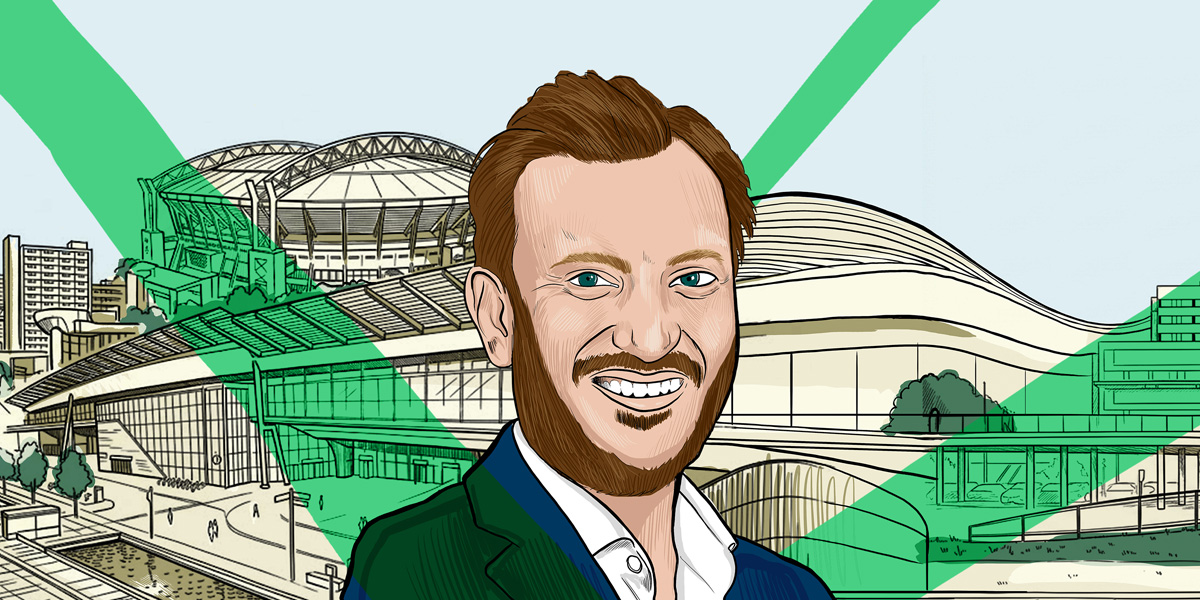
As managing director of Vastint Netherlands, Ernst-Jan van Prooye takes a long-term view of Amsterdam-Zuidoost. The company has owned the large-scale, multifunctional campuses Atlas ArenA and TreeCity, as well as two offices on Hogehilweg, for years. All the locations sit in the middle of the area, next to the future Hondsrugpark.
He therefore feels closely involved with the borough: for him, good ownership goes beyond the real estate itself. ‘A building shouldn’t only work for its users, but also add something to its surroundings,’ he says. ‘Individual projects together don’t make a city.’
Ernst-Jan sees a risk that property owners and developers only want to deliver the best within the boundaries of their own plot, while the quality of Zuidoost is determined by what happens between those buildings. Living, working, amenities and public space should therefore be considered far more in relation to one another. ‘If everyone stays on their own little island, you never arrive at a vibrant, mixed urban district.’
From closed to open campus
That vision naturally applies to the company’s own real estate as well. According to Ernst-Jan, Atlas ArenA should be not only a place where people work, but also offer something to residents and visitors from the surrounding area. ‘Our goal is for Atlas ArenA to have meaning beyond office hours.’
‘A building shouldn’t only work for its users, but also add something to its surroundings.’
That means, among other things, that more spaces are being opened up, the hospitality ‘faces outward,’ and ground-floor functions are better aligned with local needs. What is needed for that differs from place to place on the campus. The location and the people who pass by every day help determine which functions and programming fit where.
A shared area vision
Urban quality depends heavily on public space, Ernst-Jan emphasizes. That is why, in his view, creating Hondsrugpark is crucial. Vastint has been working on this for years and was a co-initiator of Stichting HondsrugPark, in which developers joined forces to realize the park. However, construction is taking longer than he would like.
For him, that touches on a more fundamental issue. ‘In an area where more and more people are coming to live, public space can’t be an afterthought. A park like this can make individual developments become far more part of a single area.’ He therefore sees a shared area vision as necessary, but also argues for sufficient flexibility and collaboration with the parties who ultimately have to deliver the plans.
Connecting two parts better
In Ernst-Jan’s view, that connection isn’t only physical. He sees opportunities to bring the office district and the surrounding residential neighborhoods closer together socially. According to him, talent from Zuidoost still finds its way only to a limited extent to the companies and workplaces on the other side of the railway.
‘In an area where more and more people are coming to live, public space can’t be an afterthought.’
‘Go all in on technology, culture, music and local entrepreneurship,’ he advises. ‘Public indoor and outdoor spaces, good hospitality and diverse programming can help bring different groups into contact more often. Not isolated initiatives, but a truly coherent whole.’
He also looks at his own role here. ‘A long-term owner can’t just wait to see what the municipality or its neighbor does.’ Vastint therefore takes part in Zuidoost City, among other things, and works with other owners, investors and housing associations to find ways to move the area forward together.
The second center of Amsterdam
You don’t make a city in a few years. ‘An area with fragmented ownership changes slowly and must be able to withstand several economic cycles. That requires owners, developers and the municipality to look beyond the next building or the next business case.’
‘A long-term owner can’t just wait to see what the municipality or its neighbor does.’
Over the next fifteen years, Ernst-Jan sees Zuidoost growing into Amsterdam’s second center, where living, working and leisure come together naturally. In his view, the combination of offices, homes, amenities, good accessibility and the large event cluster around the ArenA gives the area an exceptional starting position.
For him, the great challenge therefore lies in connecting those qualities. ‘Not only in new buildings, but in public space, in collaboration between owners and in the relationship with the people who already live in Zuidoost. Because only when those elements reinforce each other does a real city emerge.’