Amsterdam-Zuidoost | Area Development
‘We don’t plan every detail, but set the ground rules’
Ellen Nieuweboer | Gemeente Amsterdam
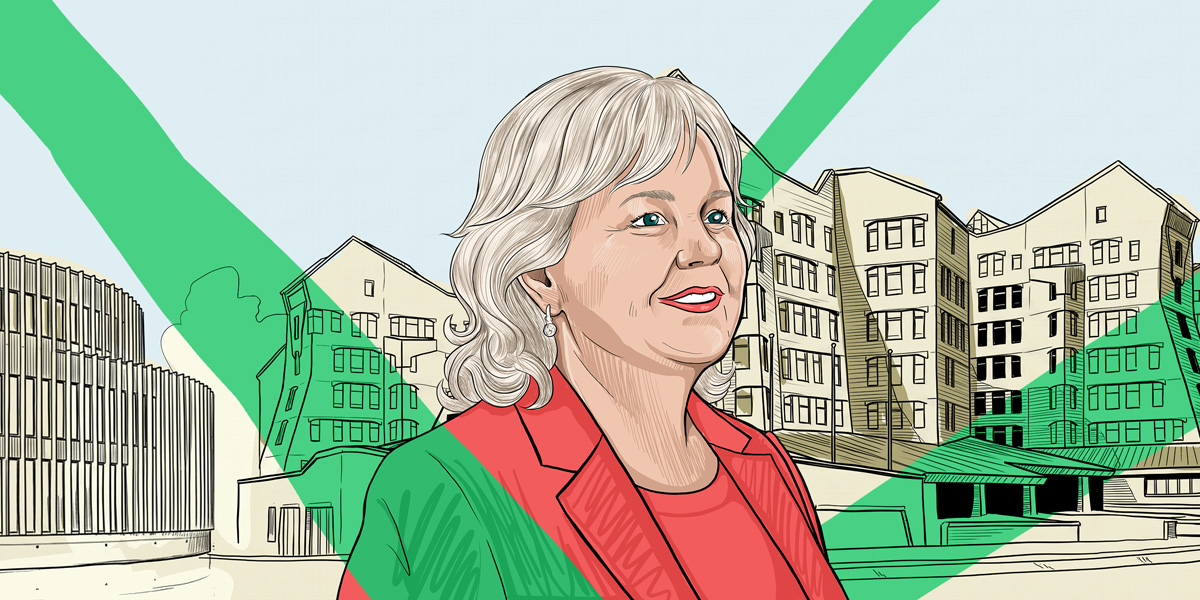
When Ellen Nieuweboer began working on the development of Amsterdam-Zuidoost nearly ten years ago, a third of the office space in the Paasheuvelweg area, the southern part of Amstel III, was vacant. While construction and investment were booming elsewhere in the city, there was hardly any activity here. Today, as project director for the Municipality of Amsterdam, she sees a very different area. ‘Pioneers found new uses for vacant office buildings, and larger players soon followed.’
That turnaround wasn’t driven by a single, fixed master plan. Ellen believes in setting a clear direction while retaining enough flexibility to respond to changing market conditions. Agreements are made at the district level, while individual developments still have room to make different choices. ‘We’re essentially building a city without having started with a master plan,’ she says. ‘We don’t plan every detail, but set the ground rules.’
That doesn’t mean market players always feel there is enough flexibility. Balancing the city’s planning framework with what the market needs, Ellen and her team are constantly looking for ways to create enough room for projects to move forward.
Creating momentum first
That flexibility only matters if it actually leads to action, and that was the challenge in Zuidoost. A former ABN AMRO building had fallen into disrepair, the Royal Bank of Scotland building stood vacant, and investors were staying away. Ellen therefore decided not to wait for the market to make the first move.
‘We’re essentially building a city without having started with a master plan.’
A chance encounter in Paris helped bring in the first major investor for the former ABN AMRO building. Ellen and her team also actively pursued opportunities for the vacant Royal Bank of Scotland building. With a laboratory permit secured quickly and its connection to the AMC, the building was able to develop into a biotech hub. Around the same time, the AMC also decided to make significant investments.
Willing to take the first step
After those early successes, more major real estate players soon followed. For Ellen, that is a clear example of how momentum can build quickly once someone takes the lead. ‘Someone has to be willing to take the first step.’
Ellen also sees continued potential for office development in Zuidoost. The municipality has acquired land near Duivendrecht station for a mixed-use development that will include housing, offices, and leisure amenities. The urban planning framework sets out what can be developed there, but who those spaces will ultimately be for has yet to be determined.
Flexibility within a clear framework
Now that the transformation is well underway, Ellen’s role is increasingly focused on setting direction. Last year, construction began on the 10,000th of the 44,000 homes planned for the area. Her role isn’t to determine every detail in advance, but to set clear parameters for what the area as a whole needs.
In Amstel III, for example, the housing mix has been set at 35% social housing, 35% mid-market housing, and 30% market-rate housing. Those percentages apply across the area as a whole rather than to each individual site, allowing individual developments to respond to changing circumstances. That flexibility is intentional, although there is still debate about how much room developers actually have within the city’s planning framework.
‘If a developer wants to build more social housing, that doesn’t automatically mean the entire housing program has to be reconsidered,’ she explains. ‘Conversely, challenging market conditions can be a reason to give developers more flexibility, as long as the commitments for the area as a whole remain intact.’
That approach reflects how Ellen sees the municipality’s role: creating momentum, working with developers, and setting direction. ‘The long-term direction is clear, but we don’t have to map out every step of the way in advance.’
One Zuidoost
That vision goes well beyond adding new buildings. For Ellen, the starting point is that ArenAPoort and Amstel III shouldn’t be developed in isolation from the Bijlmer and Gaasperdam, where significant development is also underway. That’s why she talks about one Zuidoost. ‘The goal is for existing residents to benefit as much as possible from all the new development and transformation taking place, while new residents should be able to benefit from everything the area already has to offer.’ The aim is to ensure that the transformation of ArenAPoort and Amstel III doesn’t create a divide within Zuidoost.
‘The goal is for existing residents to benefit as much as possible from all the new development and transformation taking place, while new residents should be able to benefit from everything the area already has to offer.’
For Ellen, that principle should translate into affordable commercial space on the ground floor, affordable housing for existing residents, and opportunities for young talent. But turning that ambition into reality is particularly challenging when it comes to ground-floor commercial space. The city wants to create opportunities for local entrepreneurs, but its current land-pricing system isn’t well suited to that goal.
Financial conditions
Ellen sees another important challenge here. ‘If the goal is to create affordable commercial space and opportunities for local entrepreneurs, the financial framework needs to support that ambition.’ She proposes taking a similar approach to commercial space as to housing: distinguishing between regulated and market-rate rents and adjusting land prices accordingly.
In practice, Ellen is exploring several ways to make affordable commercial space viable. These include regional funding arrangements that help reduce rents, agreements to deliver spaces with a higher-quality basic fit-out, and models in which higher returns from housing help offset lower rental income from ground-floor commercial spaces.
Investing in the bigger picture
That same entrepreneurial mindset is also reflected in public investment in Zuidoost. In 2022, Ellen realized that the city’s available funding wasn’t enough to match the area’s ambitions. So she took a proposal to the national government. What began as a funding request focused on Bijlmer ArenA station ultimately grew into a much broader investment package.
That effort secured nearly €250 million. With subsequent contributions from the Ministry of Housing and Spatial Planning, Rijkswaterstaat, and European funding programs, more than €550 million in external funding has now been secured. The funding is being used for projects including upgrades to metro stations and tunnels, cycling infrastructure, and the Smart Mobility Hub.
Always making connections
But success can also come from smaller interventions, Ellen emphasizes. She helped connect an entrepreneur who had lost their location with another organization, challenges developers when ground-floor spaces remain vacant, and organized a walk with ABN AMRO employees through tunnels and along routes where they had raised safety concerns. Together with Edge, plans were then developed to use art and lighting to make those spaces more inviting. ‘We’re constantly connecting people and opportunities. Every single day.’
‘We’re constantly connecting people and opportunities. Every single day.’
Hondsrugpark and the park north of the Johan Cruijff ArenA are also important pieces of the public realm. For Ellen, amenities like these are essential to Zuidoost’s development into a fully integrated part of the city. Neither park has been built yet, but she says funding for both has been included in the land development budget for years. She has no doubt they will happen: ‘Those parks are coming. It’s as simple as that.’
Perception has yet to catch up
Although Zuidoost is undergoing a major physical transformation, perceptions of the area haven’t always kept pace, Ellen says. Still, more and more companies are now actively choosing Zuidoost. ABN AMRO chose the area over the Zuidas, while KPN chose Zuidoost over Sloterdijk because it wanted to be in an environment that better reflects its broad and diverse customer base. ‘For companies looking for that kind of connection, Zuidoost offers something the Zuidas doesn’t.’
A city within a city
Ten years from now, Ellen hopes Zuidoost will function as a city within the larger city, with a population comparable to Nijmegen’s. She envisions an area with upgraded public transit, Hondsrugpark, a park north of the Johan Cruijff ArenA, ground-floor spaces filled with local businesses, affordable housing for existing residents, and a cultural infrastructure that reflects the size and diversity of Zuidoost. For her, the key is bringing all these elements together: offices, housing, amenities, public space, and opportunities for current residents should strengthen one another.
Ellen sees her own work as far from finished. She remains driven by the same mindset that has guided her work on Zuidoost for nearly ten years: rather than following a blueprint where every outcome is predetermined, keep moving forward, create opportunities, and adapt when circumstances change. ‘Anything is possible. “No” isn’t an option.’