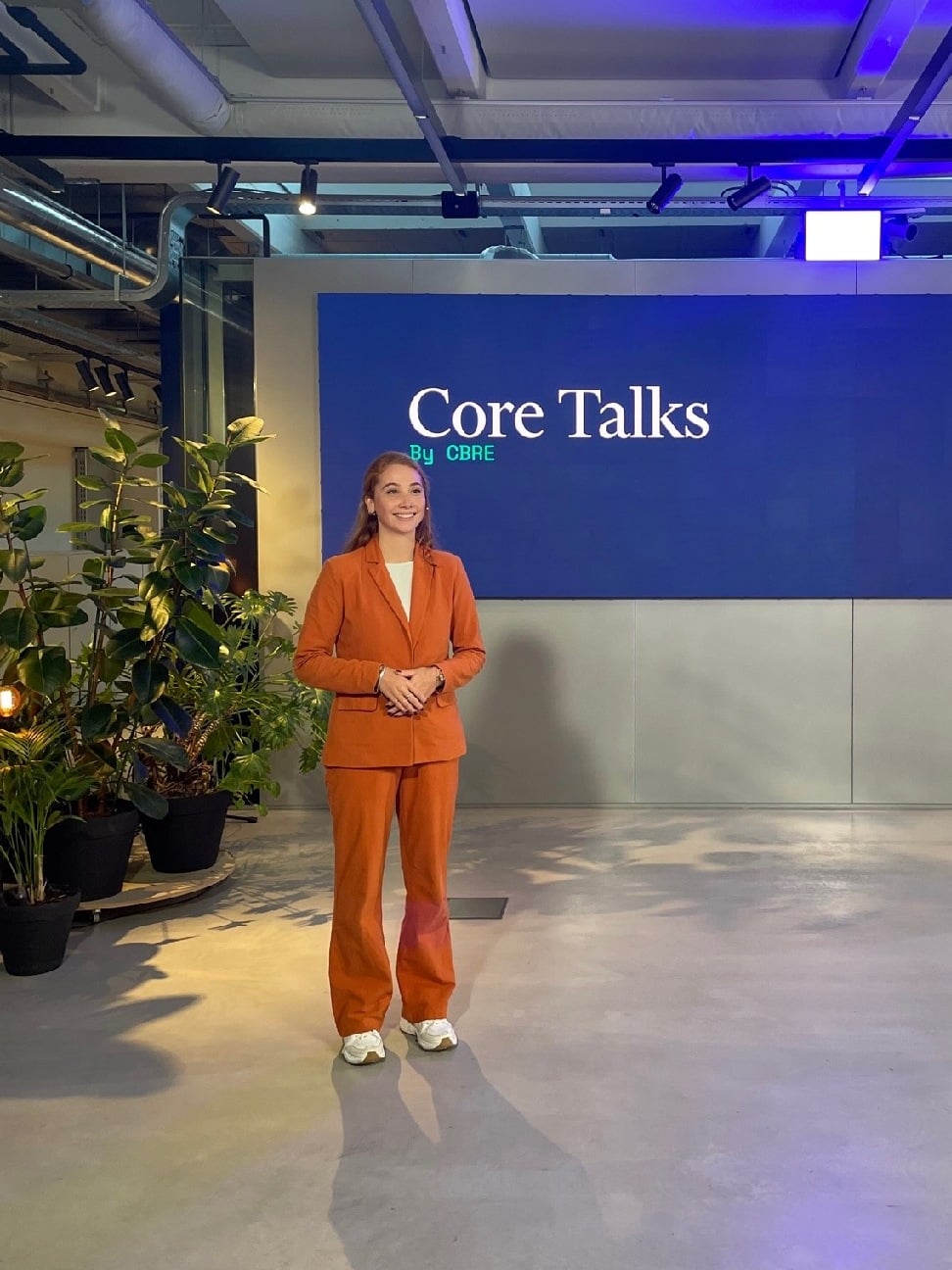
Core Talks
Key takeaways Core Talk: ESG at the top of the agenda
ESG is not only necessary, it also presents opportunities as part of a smart housing strategy. You can start using it right away in your own company, too. We have listed the key take aways for you.
Watch the recording here
-
Frank Verwoerd | Head of Research at CBRE
ESG strategy is a licence to operate for any company in the future. Driven by the rise of Gen Z, companies are increasingly forced to take social responsibility and be transparent about their operations.
Gen Z plays an important role as a catalyst for an ESG strategy at companies not only as consumers. But also because in 8 years, Gen Z will comprise 1/3 of the workforce.
If you want to retain the right talent, your operational management must be interwoven with ESG. If not, companies, consumers and employees will eventually abandon you.
Do you want to lead the way? If so, always focus more on the S of ESG. The E is increasingly being seen as 'hygiene', which should already be there at every company. -
Debby Slofstra | Country President at Schneider Electric
Housing has a significant impact on corporate sustainability. To achieve a positive effect in this area, think about reducing your footprint, making your office environment energy-efficient and using sustainable and circular materials when furnishing.
If you want to implement sustainability and/or accommodation changes in your organisation, include your entire organisation in your planning. You can do this, for example, by organising creative sessions with a good cross-section of the company to gather perspectives and create support.
Key advice from Debby Slofstra, Country President at Schneider Electric for an organisation getting started with ESG: You have to work on two sides, the hard side, which includes things such as energy, packaging and so on, but also (very importantly) the soft side, including people's behaviour. Measure the effect of your measures so you can really drive effective behavioural change. -
Jouri Schoemaker | Founder & CEO at Pieter Pot
As a company, make sure the sustainable choice is also the tempting choice. Combine sustainability and convenience into: ecovenience (eco-friendly + convenience). In that way, you seduce your target audience with a win-win situation.
A good idea for sustainability is an important start. But the challenge is then in the realisation; in the implementation of that idea. Validating your idea and continuing to validate it is a crucial step in developing something and investing in something that actually works. Validation can already be done on a small scale (see Pieter Pot's flyer experiment), but it is really essential and helps you get people excited about your idea.
When you start implementing ESG, choose an aspect of ESG that touches and motivates you personally. Don't become fixated on the entire spectrum of ESG, but start with something for which you feel intrinsic motivation. Once you are successful in that, the further rollout of a broader ESG policy can follow. -
Bob Hendrikx | CEO & Founder Loop Biotech
Loop has developed a living coffin made of mushrooms. An entirely local, Dutch product.
A sustainable product does not automatically mean you have a sustainable organisation. To really follow through on this, Bob (CEO and founder of Loop) says: 'For every choice you make, choose the most sustainable option. Whether it's transporting your product, or lunch for your staff.'
In doing so, he argues, if you look at the people in your organisation: 'See your people as elite athletes. Work hard, but take good care of yourself, as well. For instance, we regularly have a masseur in the office, we offer a dodgeball room for relaxation and every employee has a personal development plan'. -
Frank Holierhoek | Sales Manager at a.s.r. Vitality
Increasingly high on the agenda of companies is ampliation, a form of positive organisational psychology. Ampliation focuses on strengthening and empowering all employees, rather than preventing or rehabilitating a limited group. Want to know more about ampliation?
Some tips for getting started with employee vitality yourself: Ensure that employee vitality is supported by management and HR, but also that it becomes something for which the entire organisation takes responsibility. You can achieve this, for example, by working with various leaders from within the organisation who can set up and roll out initiatives. Establishing an annual calendar on vitality ensures that this topic receives attention throughout the year.
In addition, as a manager, set a good example in terms of vitality. Teams in which the manager takes an active role in this area get moving faster, literally and figuratively. Consider, for example, initiating walking meetings, show that you yourself sometimes exercise during working hours and express what this does for your productivity. And above all, have a conversation with your team: What do you need? What energises you? How can I help you achieve this?
