Amsterdam-Zuidoost | Area Development
‘Amsterdam Southeast has all the characteristics of a 15-minute city’
Andro Bottse | Zuidoost City
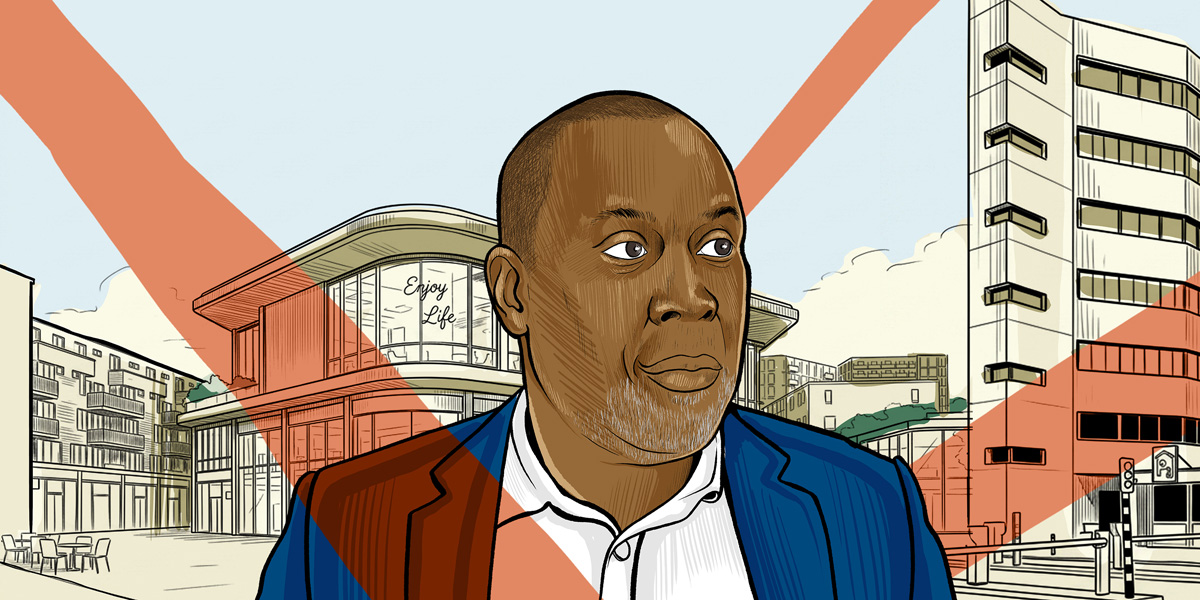
As Managing Director of Zuidoost City, Andro Bottse is committed to the business districts around ArenA Poort and Amstel III. His commitment to the area is deeply personal. He lives in Amsterdam Southeast, does his grocery shopping there, and cycles to work in twelve minutes. The golf course and the Ajax stadium he frequently visits are both nearby. These days, he says he only visits Amsterdam’s city centre ‘as a tourist.’
For Andro, Southeast is not an area that still needs to evolve into a true urban neighbourhood. It already offers everything that makes up daily life. The challenge is to view the area through a different lens, make better use of its strengths, and create space for the diverse communities and lifestyles that coexist there. ‘Southeast has all the characteristics of a 15-minute city,’ he says. ‘All essential daily amenities can be reached within fifteen minutes. You can be born here and grow old here. There’s no real reason to leave, because we already have everything.’
Take a different perspective on Southeast
According to Andro, the gap between reality and the image of Southeast is primarily a communication challenge. In his view, the area has much to offer but does not communicate its strengths effectively enough. He points to media framing, Southeast’s own modesty, and a lack of channels to tell a different story. His message is captured in the campaign ‘Take a different perspective on Southeast.’
‘There’s no real reason to leave, because we already have everything.’
This alternative perspective begins with recognising what is already there. Businesses in the office and commercial districts still receive significant value for money, while accessibility is excellent and Schiphol Airport is only a short distance away. Talent from the wider metropolitan region is also within easy reach. ‘Yet those advantages are still not being utilised enough,’ he says. ‘I see it as my mission to make them more visible.’ More than one identity
People often speak about Southeast as if it were a single, unified district. Andro sees it differently. ‘ArenA Poort and Amstel III have a very different history and purpose from the Bijlmer. Those differences exist, and they can remain.’
Nor does every part of Southeast need to be culturally unified. Instead, he sees value in creating space for different communities and places to retain their own character. ‘To me, coexistence does not mean that everything must be brought under a single identity. Different communities can exist side by side and evolve organically. That diversity is one of Southeast’s greatest strengths.’
‘To me, coexistence does not mean that everything must be brought under a single identity.’
At the same time, he sees opportunities to create stronger physical connections between the area's different neighbourhoods. He envisions a boulevard-style pedestrian route linking ArenA Poort and the Bijlmer, passing African and Caribbean shops and places where visitors can spend time. According to him, the public space available for this purpose is currently far too underutilised.
Residents and businesses at the table
For the continued development of the area, Andro believes it is important to consider who gets a seat at the table. People who live at a distance should certainly be able to contribute their views, but he believes the interests of those who live and work there every day should carry the greatest weight in decision-making. He specifically mentions the importance of involving new residents.
The same applies to businesses. In his view, they have very little influence in participation processes, something that clearly frustrates him. ‘They consciously chose Southeast and can contribute enormously to the future of the area.’
He also highlights the importance of the middle-income population in Southeast. While this group has purchasing power, much of that spending occurs outside the area because the local offerings do not yet fully meet their needs. ‘More amenities for this group would not only meet a local demand but could also encourage people to stay in the area for longer.’
From destination to place to stay
At present, visitors often come to Southeast with a specific purpose and leave immediately afterwards. According to Andro, this is partly related to the quality of the public realm. He points to uninviting parking garages, routes that are difficult to walk or cycle through, and curbs that make the area less accessible for wheelchair users.
‘If you want to be part of this area, you have to invest in it as well.’
Cleanliness and safety are his highest priorities. Yet he believes this responsibility does not rest solely with the municipality. Businesses and developers must also contribute. ‘If you want to be part of this area, you have to invest in it as well.’ In return, he believes greater opportunities should be given to take initiative in improving public spaces. He also specifically highlights the importance of ensuring women feel safe when travelling home.
According to Andro, the area also lacks inviting hospitality venues, museums and other attractions that draw people to Southeast. ‘Facilities like these can help create a place where people do not just come for work or an event, but where they genuinely want to stay.’
A little better every day
When Andro looks ten years ahead, he does not see a single vision that the whole of Zuidoost should fit into. Instead, he hopes to see an area that continues to evolve organically. ‘I imagine a place where differences can coexist and where people can still live together comfortably. It is my personal ambition to contribute to that vision; to make Southeast a little better every day.’